MỤC LỤC BÀI VIẾT
- What Is Dew Point?
- Dew Point in Compressed Air
- Guide to Determining the Required Dew Point for a Compressed Air System
- How to Achieve the Required Compressed Air Dew Point
- How to Determine the Current Dew Point of Compressed Air
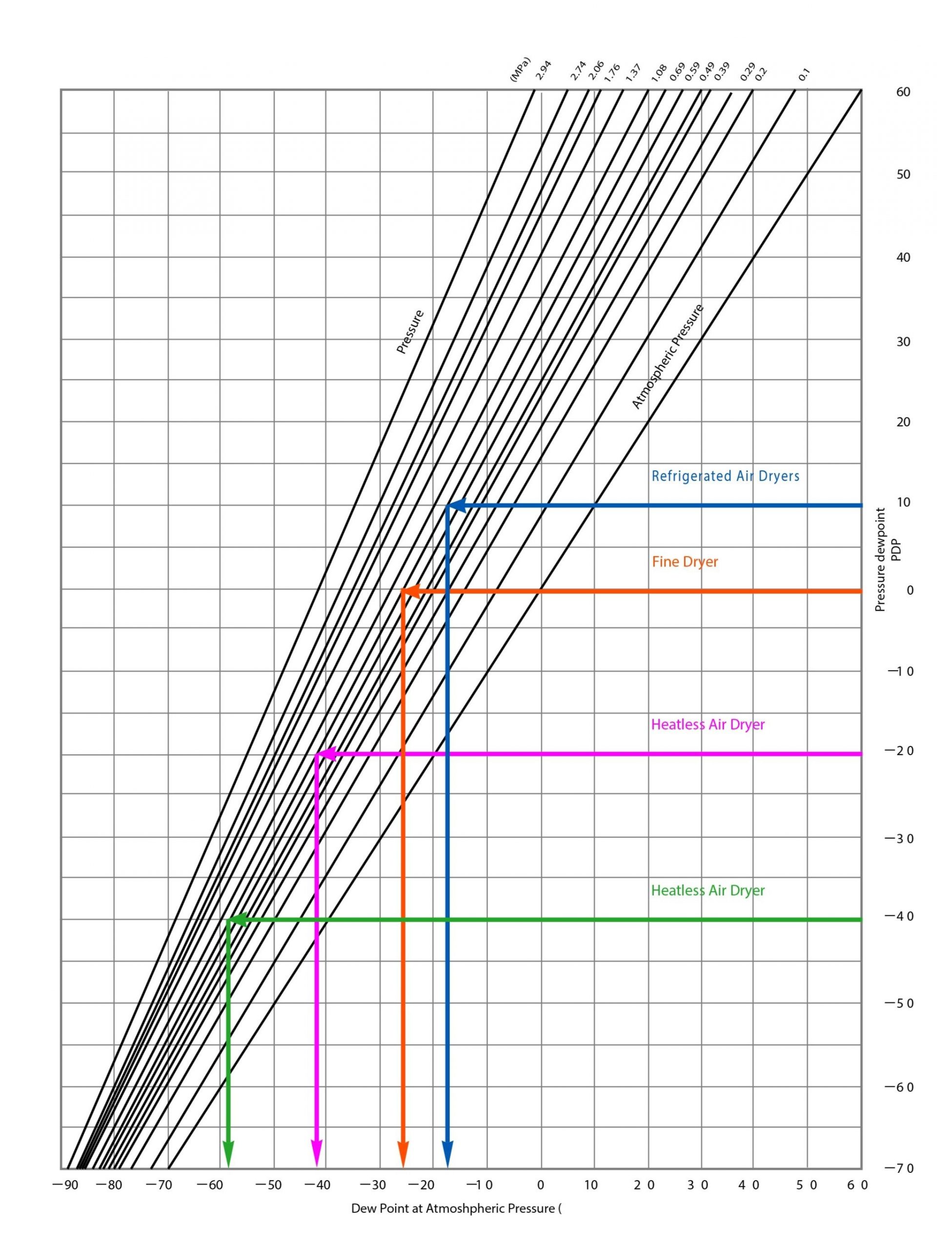
- Conversion Table Between Pressure Dew Point (PDP) and Atmospheric Dew Point (ADP)
What Is Dew Point?
The most common parameter used to determine the water content in air is the dew point.
Dew point is the temperature at which air becomes saturated with water vapor and condensation begins to form. In simple terms, it is the temperature at which “dew” appears. Dew point is always expressed as a temperature value.
Example: If an air stream has a dew point of 10°C, water vapor will only begin to condense into liquid when the air temperature drops below 10°C.

Practical Example: When a cold beverage can is placed in ambient air, water droplets often form on the outside of the can. This happens because the dew point of the surrounding air is relatively high (for example, 28°C).
When the can temperature is around 15°C, which is below the ambient dew point, moisture in the air condenses and forms water droplets on the can surface.
The Lower the Dew Point, the Drier the Air
A lower dew point indicates drier air, meaning less water vapor is present.
Dew Point in Compressed Air
The same principle applies to compressed air systems.
The dew point of compressed air is the temperature at which water vapor in the compressed air begins to condense into liquid water.
Example
If compressed air has a dew point of 5°C, liquid water will only appear when the compressed air temperature drops to 5°C or lower.
Pressure Dew Point (PDP)
The Pressure Dew Point (PDP) is the dew point of compressed air measured at a specific operating pressure. PDP is the key indicator used to evaluate the dryness of compressed air after it passes through an air dryer.
PDP vs. ADP – Important Distinction
It is important to clearly distinguish between:
- Pressure Dew Point (PDP): Dew point measured at the actual compressed air pressure
- Atmospheric Dew Point (ADP): Dew point referenced to atmospheric pressure (1 bar)
These two values are not interchangeable and must be specified correctly when evaluating compressed air quality or compliance with standards such as ISO 8573-1.