
Compressed Air Piping Installation for Factories: Key Technical Considerations
In a manufacturing facility, compressed air piping directly affects pressure at the point of use, equipment stability, air losses, and compressor electricity costs. An inadequately designed piping system can cause low pressure at the end of the line, air leakage, condensate buildup, and difficulty expanding production capacity.
This article helps factory engineering, maintenance, and management teams understand the key considerations when installing compressed air piping: pressure drop, leakage, condensate, material selection, piping layout, and future system expansion.
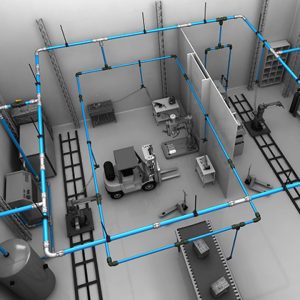
Main Contents
The sections below focus on the practical needs of factories investing in, expanding, or upgrading a compressed air system.
Why Should Factories Pay Attention to Compressed Air Piping?
Many factories focus on selecting the air compressor while overlooking the air distribution system. In practice, the piping determines whether compressed air reaches the right location at the required pressure and quality.
Pressure Drop Causes Unstable Equipment Operation
If the piping is too small, too long, or poorly arranged, pressure at equipment located at the end of the line can be much lower than the compressor set pressure.
Higher Compressor Power Consumption
When pressure drop is excessive, factories often raise the compressor set pressure to compensate. This may keep the equipment running, but it forces the compressor to work harder.
Limits Future Production Expansion
If the main header has insufficient spare capacity, adding new machines or production lines can cause pressure fluctuations and require extensive piping modifications.
When Should a Factory Install New Compressed Air Piping or Upgrade an Existing System?
Low pressure is not always caused by an undersized air compressor. In many cases, the cause lies in the piping, valves, filters, air dryer, or overall system layout.
When a New System Is Recommended
- A new factory is installing a centralized compressed air system.
- A new production line is being added or the factory is being expanded.
- The compressor room is being relocated.
- Compressed air must be supplied to multiple production areas.
- The system must support expansion over the next several years.
When an Existing System Should Be Upgraded
- Equipment at the end of the piping network frequently experiences low pressure.
- The compressor set pressure must be increased above normal to meet demand.
- The existing piping leaks heavily, has deteriorated, or is difficult to repair.
- Excessive condensate appears at compressed air points of use.
- The old system lacks isolation valves for individual areas, making maintenance difficult.
Common Technical Problems in Compressed Air Piping Systems
A compressed air piping system may still operate without being optimized. Small design and installation errors can have long-term effects on production.
End-of-Line Pressure Drop
Cylinders become weak, packaging machines run slowly, pneumatic valves respond inconsistently, or equipment faults occur only when several machines operate at the same time.
Compressed Air Leakage
Small leaks at threaded joints, elbows, tees, valves, or quick couplings can continuously waste compressed air and increase compressor run time.
Water in the Piping
Condensate can damage solenoid valves, cylinders, and pneumatic tools, and may affect product quality in certain processes.
Difficult Area-by-Area Maintenance
Without properly placed isolation valves, repairing a small branch can affect several other production areas.
Insufficient Spare Capacity in the Main Header
When a factory adds machines or production lines, an undersized main header can cause pressure fluctuations and air shortages in distant areas.
Poor Piping Route Arrangement
Long, indirect routes, excessive sharp bends, or poorly arranged take-off branches can increase pressure loss and make condensate control more difficult.
Key Technical Factors to Consider Before Installing Compressed Air Piping
Before installing a new compressed air piping system or upgrading an existing one, the factory should clearly determine air demand, operating pressure, future expansion requirements, and areas at risk of pressure drop. These factors directly affect production-line stability.
1. Actual Compressed Air Demand
Determine the total air demand of the equipment currently in use and include spare capacity for future factory expansion. If the system is sized only for current conditions, it may quickly become undersized when new machines are added.
2. Pressure at the Point of Use
The pressure that matters is the actual pressure at the production machine, not only the compressor set pressure. Piping, filters, air dryers, and valves can all create pressure loss.
3. Main Header and Branch Pipe Diameters
Undersized piping increases air velocity, friction, and pressure drop. The main header should include reasonable spare capacity so the factory can add more compressed air points in the future.
4. Piping Route and Layout
For factories with several production areas, a ring-main or combined layout is generally more stable than a simple linear layout. A well-designed arrangement distributes compressed air more evenly and reduces low pressure at the end of the line.
5. Condensate in the System
The piping must include an effective condensate drainage arrangement, especially at low points. Water in the piping can affect solenoid valves, cylinders, pneumatic tools, and product quality.
6. Ability to Isolate Individual Areas
Area isolation valves allow maintenance, repairs, or expansion without shutting down the entire compressed air system. This is particularly important for factories operating continuously.
How Does Compressed Air Piping Layout Affect Factory Stability?
Piping layout directly affects pressure drop, maintainability, and future expansion. In factories with several production areas, a single simple pipeline is often unsuitable when air demand is high or expansion is planned.
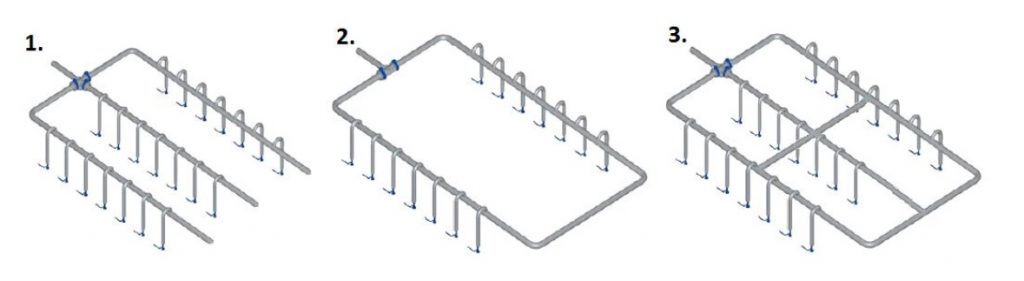
Examples of compressed air piping layouts used in factories.
Linear Layout
Suitable for small systems with few air points, short pipe runs, and limited expansion requirements. Its main disadvantage is that the end of the line can experience pressure drop when flow demand increases.
Closed-Loop Layout
Suitable for factories with several production areas. Compressed air can reach each point from multiple directions, improving pressure stability and reducing the risk of localized air shortages.
Combined Layout
Often suitable for large factories: the main piping is arranged as a ring or large header, with branches serving individual areas. This is a flexible solution for factories planning future expansion.
Selecting Compressed Air Piping Materials: Consider Durability and Operating Conditions
Piping material affects durability, air cleanliness, installation time, leak resistance, and ease of future modification. Factories should select materials based on actual operating conditions, not only the initial material cost.
| Material | Suitable Factory Applications | Advantages | Selection Considerations |
|---|---|---|---|
| Aluminum Compressed Air Piping | Factories requiring a clean, attractive, quick-to-install, and easily expandable system. | Lightweight, corrosion-resistant, easy to reconfigure, and visually clean. | Higher initial material cost than steel; compatible system fittings should be used. |
| Galvanized Steel Piping | General industrial compressed air systems with a moderate budget. | Widely available, predictable material cost, and good mechanical strength. | Pay attention to thread and joint quality, as well as the risk of internal corrosion over time. |
| Stainless Steel Piping | Food, pharmaceutical, electronics, and other environments requiring clean air or corrosion resistance. | Excellent corrosion resistance, high cleanliness, and long service life. | Higher cost; installation must be carried out correctly to ensure leak-tight joints. |
| Black Steel Piping | Certain utility routes, compressor rooms, or industrial systems requiring high mechanical strength. | Good mechanical strength and suitable for certain large-diameter routes. | Requires rust protection, internal cleaning, and debris control before commissioning. |
Technical Information to Prepare Before a Compressed Air System Survey
The more complete the initial data, the more accurately the compressed air piping proposal can match the factory's actual operating requirements.
Air Supply Information
- Number of existing air compressors.
- Power rating and flow capacity of each compressor, in m³/min or m³/h.
- Compressor set pressure and required pressure at the point of use.
- Information on air receivers, air dryers, and filters, if already installed.
Air-Use Point Information
- Current number of compressed air take-off points.
- Location of each machine or compressed air use area.
- Which equipment has high air consumption or requires stable pressure.
- Plans to add machines, production lines, or future expansion.
Factory Building Information
- Factory layout drawings, if available.
- Preferred pipe installation height.
- Areas where drilling, welding, lifting, or work at height is restricted.
- Available installation periods that minimize disruption to production.
Compressed Air Quality Requirements
- Whether compressed air is used for actuators, pneumatic tools, or direct product contact.
- Whether dry air, clean air, oil filtration, or water removal is required.
- Whether any area requires separate pressure regulation or point-of-use filtration.
- Whether there are special environmental, temperature, or humidity requirements in the factory.
Technical Checks After Compressed Air Piping Installation
After installation, the factory should perform several basic technical checks to confirm stable operation, adequate pressure at the point of use, and the absence of leakage or condensate problems during operation.
Check for Compressed Air Leakage
Inspect joints, valves, elbows, tees, and capped outlets. Even small leaks cause continuous air losses and increase compressor run time.
Check Pressure at the Most Distant Point
Pressure should be checked in the area farthest from the compressor room, especially when several machines consume air at the same time.
Check for Condensate
Inspect low points, drain points, and end-of-line areas to prevent water from reaching compressed air equipment.
Check Area Isolation Capability
Major areas should have separate isolation valves to simplify future maintenance, repairs, or system expansion.
Compressed Air Piping Must Be Considered as Part of the Complete System
Compressed air piping is only one part of the system. To provide stable, dry, and clean compressed air at the point of use, the factory must consider air generation, air treatment, and air distribution together.
Compressor Room
Air compressors, air receivers, air dryers, and filters should be arranged in the correct sequence. An overheated or poorly ventilated compressor room, or an incorrectly arranged outlet pipe, can reduce overall system performance.
Point of Use
At each machine or production area, the factory may require an isolation valve, pressure regulator, water separator, FRL unit, or fine filter depending on the equipment requirements.
See also: compressed air system calculation formulas, air dryers, compressed air receivers, pressure unit converter.
Frequently Asked Questions About Compressed Air Piping Installation
The questions below are intended for factory engineering, maintenance, and management teams preparing to invest in a compressed air system.
Should a Factory Use Aluminum, Stainless Steel, or Galvanized Steel Piping for Compressed Air?
Is Low Pressure at the End of the Line Always Caused by an Undersized Air Compressor?
Does Compressed Air Piping Need a Closed-Loop Design?
Where Does Water in Compressed Air Piping Come From?
What Should Be Checked After Compressed Air Piping Installation?
Need a Compressed Air System Survey at Your Factory?
If your factory is experiencing low pressure at the end of the line, compressed air leakage, water in the piping, an outdated system that is difficult to expand, or requires a compressed air system for a new production line, IMX can conduct an on-site survey and propose a suitable technical solution.
IMX aims to help factories achieve a compressed air system that operates reliably, maintains adequate pressure at the point of use, minimizes air losses, is easy to maintain, and can be expanded as production grows.